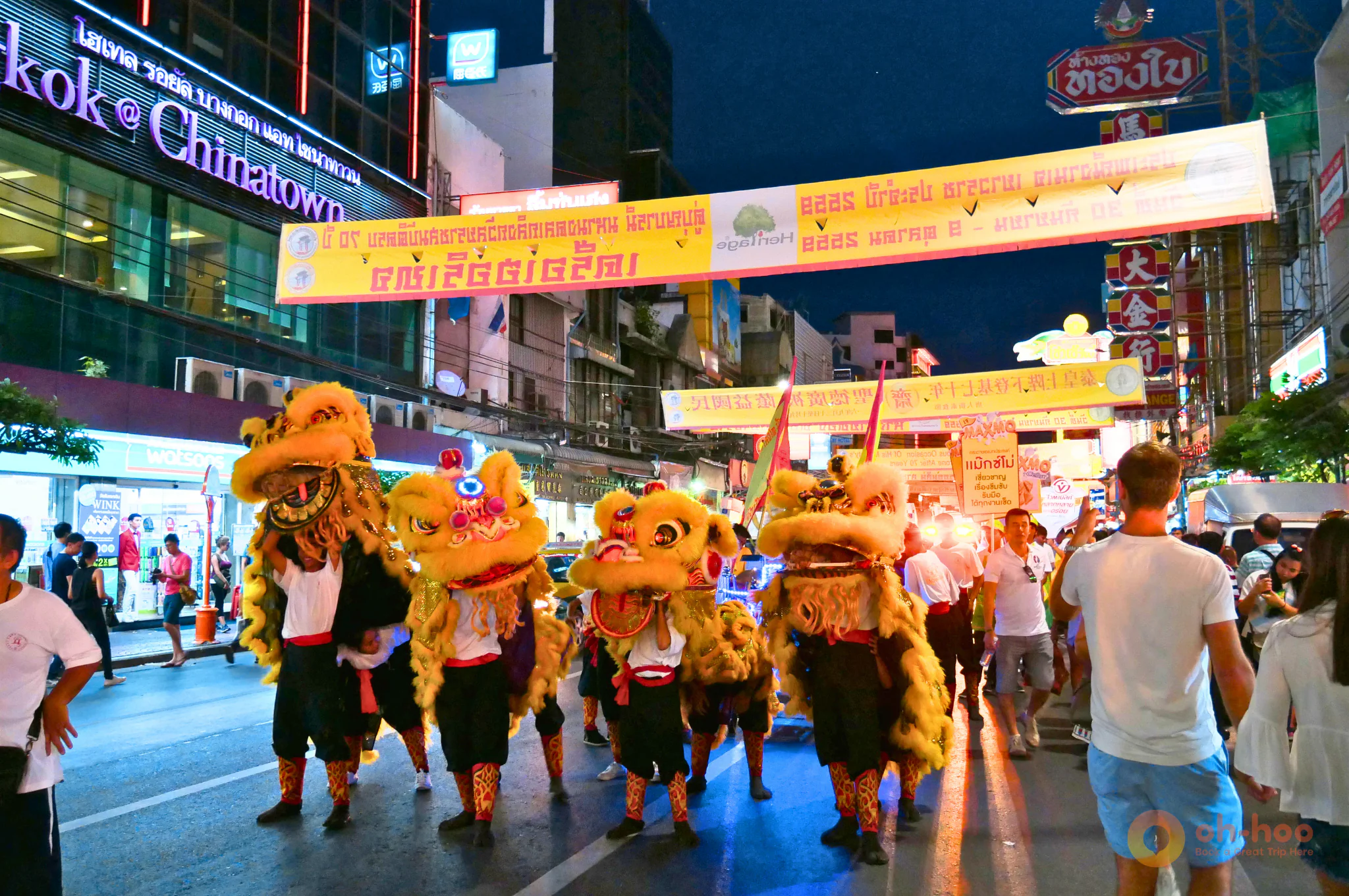
Quick Answer: From 10 to 18 October 2026, Yaowarat Road turns yellow with Jay flags.
Come hungry in the evening for plant-based Chinese-Thai street food, and spend the morning at the Grand Palace, Wat Pho, and Wat Arun – one day that shows how comfortably Bangkok carries two cultures at once.
Look up at a Yaowarat stall during these nine days, and you will see a small yellow flag with a red character on it, strung above a wok that is turning out green curry. The flag is Chinese. The curry is Thai. Nobody standing in the queue finds that remarkable, and that is the whole story of this festival.
When Is the Vegetarian Festival in Bangkok 2026?
The Bangkok festival runs 10 to 18 October 2026, the same nine days as Phuket’s, because both follow the ninth lunar month (as of 2026 – the dates shift each year).
Everything centres on Yaowarat Road, with Wat Mangkon Kamalawat – the great Chinese temple halfway along – as the spiritual anchor. Stalls start setting up in the late afternoon, lanes of the road close to traffic, and by seven in the evening the street is shoulder to shoulder. Mornings are for the temple; evenings are for the food.
The Heart of Yaowarat Vegetarian Festival
This Taoist tradition honors the Nine Emperor Gods, star deities brought to Thailand by Chinese families generations ago. During the festival, Yaowarat turns into a vibrant hub of plant-based street food and merit-making.
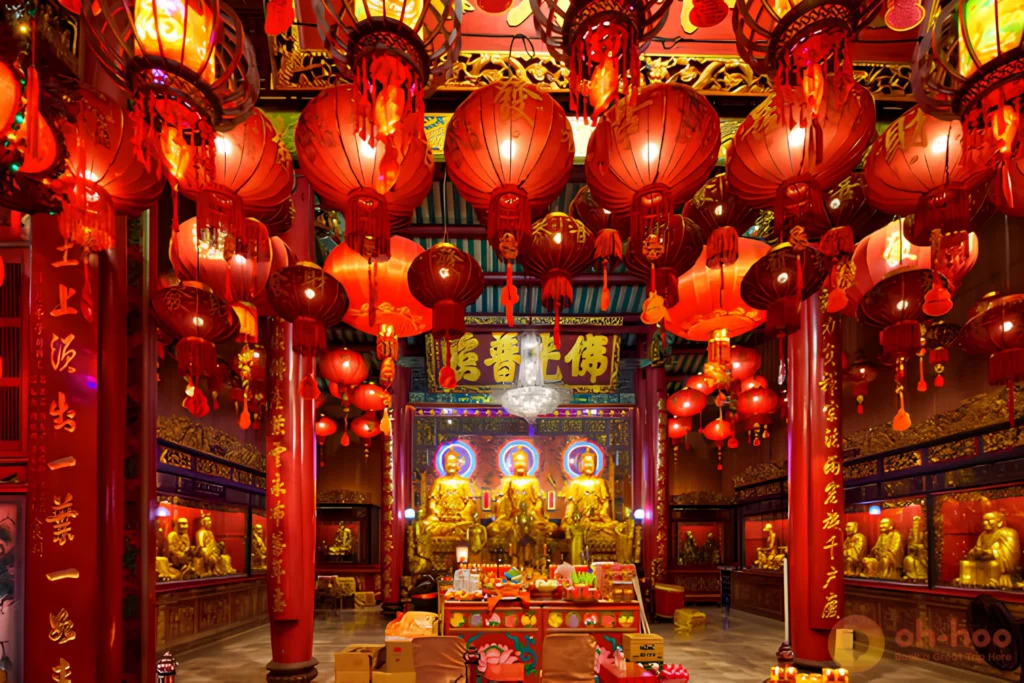
Visitors come to light incense at Wat Mangkon Kamalawat and enjoy authentic Teochew dishes alongside modern Jay versions of street-food favorites. Whether you are observing the festival’s traditions or simply looking for exceptional food, the lively energy of Yaowarat makes it one of Bangkok’s most memorable annual events.
Thailand has absorbed Chinese religious practice for centuries without either tradition having to give ground, and for nine days a year that arrangement is on open display with a wok under it.
What Jay Food Means
Jay is not simply the Thai word for vegetarian. It is a religious diet with rules that go well past leaving out the meat.
- No meat, poultry, seafood, eggs, dairy, or honey. In practice, Jay is fully vegan.
- No fish sauce, oyster sauce, or shrimp paste – which is why so much Thai cooking has to be rebuilt from scratch for these nine days.
- None of the five pungent vegetables: garlic, onion, chives, leeks, and shallots. They are avoided because they are believed to stir the senses and work against a calm mind.
- No alcohol, and devotees also abstain from stimulants and keep what they can of their thoughts clean. The diet is one part of a nine-day vow, not the whole of it.
- Nine days, for the nine gods being honoured.
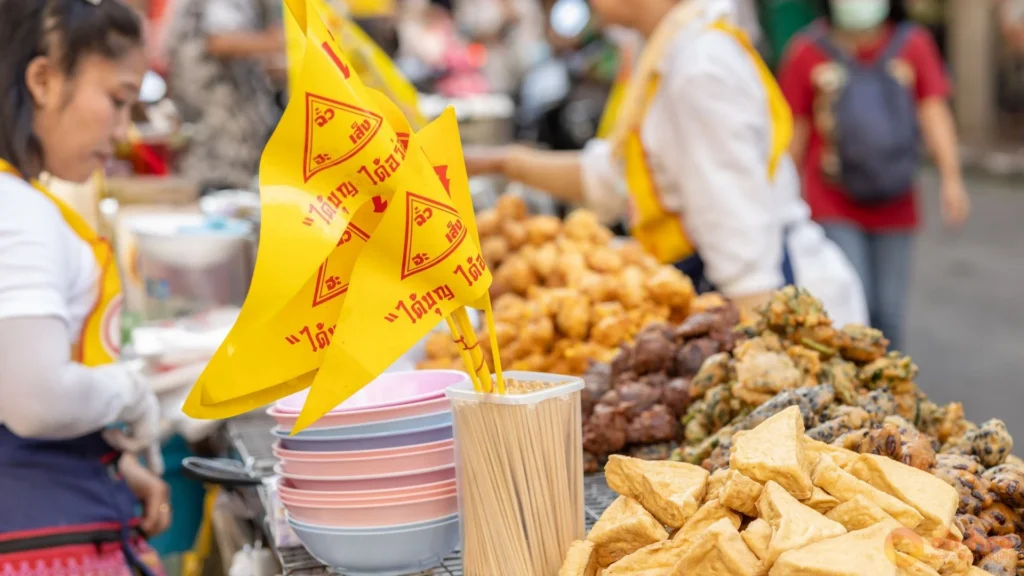
The yellow flag with the red character – เจ in Thai, 齋 in Chinese – is the certification. It means the kitchen is following all of the above, and it is the only label you need on the street.
And the white clothing you will see on the older devotees is the same idea worn rather than eaten: white for purity, for the duration of the vow. Visitors are welcome exactly as they are – no one expects you to dress up to buy noodles.
What to Eat at the Yaowarat Vegetarian Festival
Start at Wat Mangkon Kamalawat and walk in either direction. These are the things to look for.
- Mock meat: “duck”, “pork” and “fish” built from soy protein, wheat gluten and mushroom, some of it startlingly convincing. It exists so that families can keep the vow without giving up the dish they always eat, which tells you something about how seriously both halves are taken.
- Jay noodle soup: clear mushroom and soy broth, tofu, greens, sometimes hand-cut noodles. In Chinese custom, long noodles stand for long life, which is why they are never cut short on the plate.
- Steamed and fried dumplings: mushroom, taro, water chestnut, cabbage, done best at the Teochew end of the street.
- Jay pad thai and Thai curries: green curry, massaman and pad thai rebuilt without fish sauce or shrimp paste, using soy and mushroom for depth. This is the clearest taste of the Thai-Chinese overlap on the whole street.
- Tofu, every way: silken in syrup, fried in cubes, braised dark and sweet, grilled on skewers. Chinatown treats tofu as a main ingredient rather than a substitute.
- Fried taro and pumpkin fritters: hot, crisp, sold by weight, eaten standing up.
- Sweets: black sesame soup, soy milk with ginkgo, jelly with longan, water chestnuts in syrup. Watch for condensed milk sneaking into drinks, which is not Jay.
Three practical things: come after 5 pm, bring cash in small notes because almost nobody takes cards, and eat in small rounds rather than one big plate – the point of the street is to keep moving.
A One-Day Bangkok Plan: Temples by Morning, Yaowarat by Night
The morning half is the Bangkok Grand Palace, Wat Pho & Wat Arun Tour a four-hour experience led by a licensed guide, with admission to all three sites and water included. Meeting at River City at 07:30 puts you in the perfect spot for the day. Groups are capped at 15 participants (ages 5 to 80), ending around midday so you can rest before heading to Yaowarat.
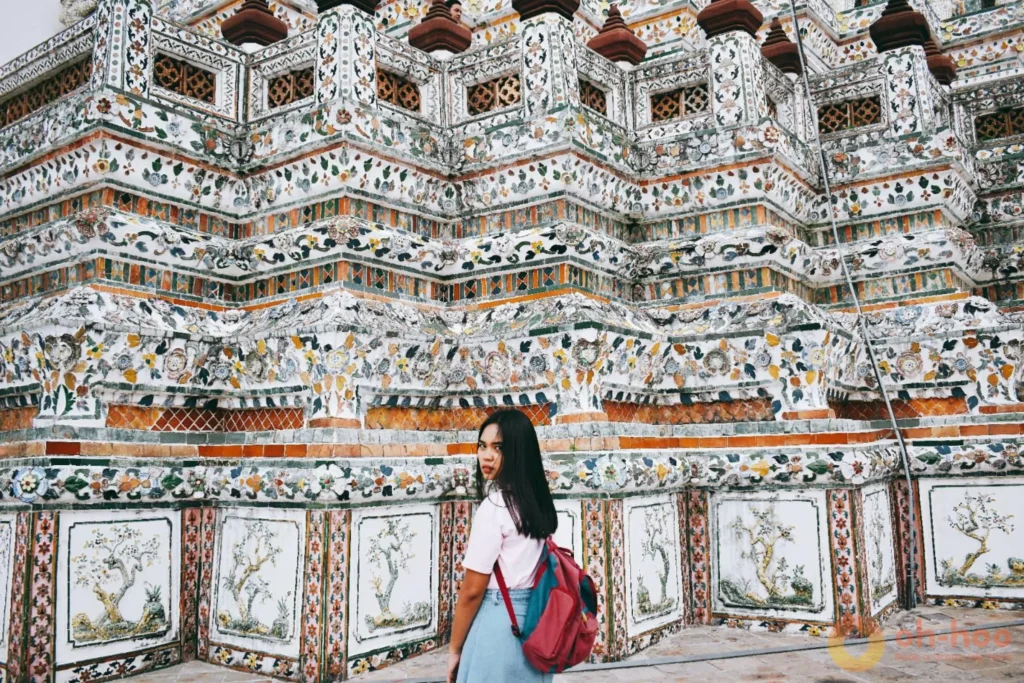
Keep an eye out at Wat Arun for the central spire covered in Chinese porcelain—a preview of how Thai and Chinese cultures blend before you taste it in Yaowarat tonight.
(Note: Dress politely with shoulders and knees covered. Our full guide to visiting the palace covers dress code details, and if you are planning the rest of your trip, our one-day city route offers a broader look.)
Tips for Visiting
- Take the MRT to Wat Mangkon station: it comes up on Charoen Krung Road, a two-minute walk from the temple and the top of the food stretch.
- Or arrive by river: The Chao Phraya boats run to Ratchawong pier, and walking up from the water is the better entrance.
- Go on a weekday evening if your dates allow: Weekends are the full crush.
- Wear something you can move in: It is hot, close, and crowded, and the street is a slow shuffle after seven.
- White is customary rather than required: Wear it if you want to be part of the atmosphere; nobody will mind if you do not.
- At the temple, step aside rather than block the aisle, and ask before photographing anyone praying.
- Pace yourself: Nine days of this food would be no hardship at all – our guide to eating in Thailand explains what you are tasting the rest of the year.
FAQ
A: 10 to 18 October 2026, centred on Yaowarat Road and Wat Mangkon Kamalawat in Chinatown. The dates follow the ninth lunar month and move each year.
A: Anything under the yellow Jay flag is – no meat, seafood, eggs, dairy, honey, fish sauce or shrimp paste, and no garlic or onion either. Watch drinks and desserts, where condensed milk sometimes appears outside the Jay rules.
A: It carries the red character เจ (齋, “jay”) and certifies that the stall is cooking to the full festival diet. It is the quickest way to order with confidence.
A: Easily. The palace, Wat Pho and Wat Arun fill a morning, the festival stalls get going from late afternoon, and the two areas are a short ride apart – which is why this is the one week a year when a single day in Bangkok does both.
One Street, Two Traditions, Nine Nights
Bangkok spends most of the year being several cities at once without making a point of it. For nine days in October it makes the point: a Taoist festival on a Buddhist street, Thai curries cooked to Chinese rules, and a queue of people who are there for the dumplings and happy to light incense while they wait.
Do the temples first. The Bangkok Grand Palace, Wat Pho & Wat Arun Tour meets at 07:30 and has you finished by lunchtime, with the whole evening open – and by then you will have seen the Chinese porcelain on Wat Arun’s spire, so you will know exactly what you are looking at when the yellow flags come out.