Damnoen Saduak Floating Market: Entrance Fee, Hours & Best Time to Visit
Is There a Damnoen Saduak Floating Market Entrance Fee?
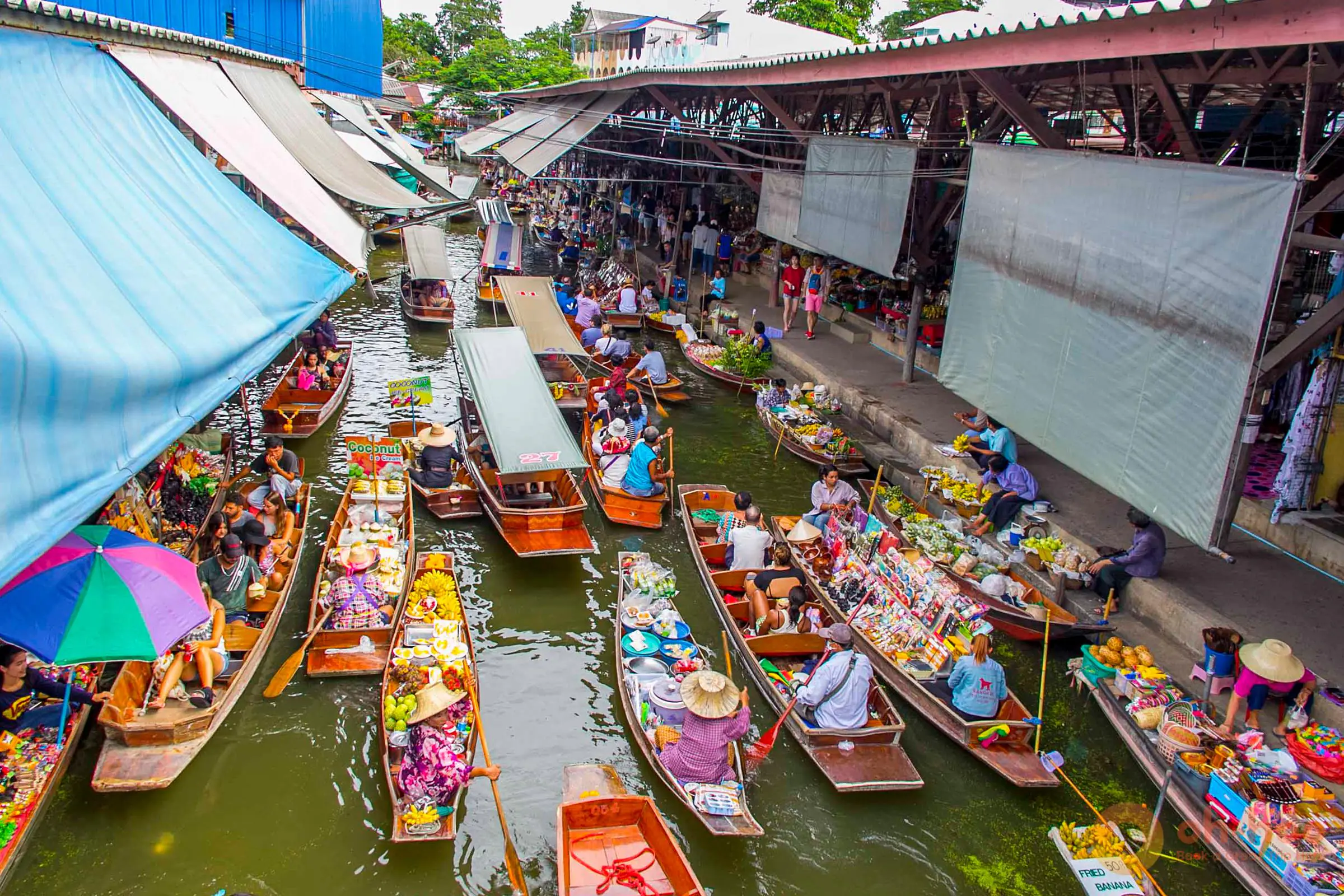
No. There is no Damnoen Saduak floating market entrance fee – it is a working canal with public walkways, not a ticketed attraction, and nobody charges you for turning up.
That surprises people, because the search results all imply there is a gate somewhere. There is not. What there is instead is a set of optional costs once you arrive, and those are what the day runs on.
What You’ll Actually Pay
There’s no entrance fee to get in you’ll only start spending money when you decide to hire a boat, pay for parking, or buy food and souvenirs.
- A boat, if you want one. Much the highest cost of the day, and it varies by pier and boat type – a few hundred baht for a paddle boat, into four figures for a private long-tail. Rates are usually quoted per boat, not per person, which changes the maths for a group. Our how boat hire actually works covers the details.
- Parking, if you drive. A small charge at the car parks near the market, paid on the way in or out.
- Whatever you buy. Food, drinks and souvenirs, at prices that climb the closer you get to the busiest stretch of canal.
On a booked tour, the boat fee is usually already in your ticket, which removes the biggest variable from the day. Check your confirmation for which boat is included and whether anything is offered as a paid extra on site.
Opening Hours
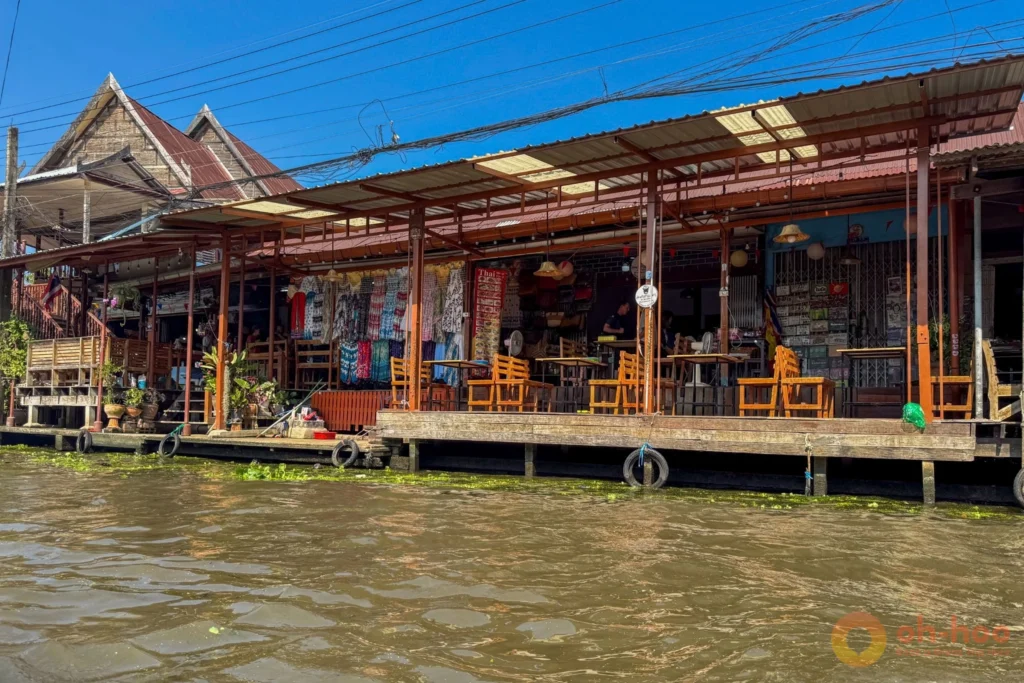
The market runs on a morning schedule and finishes earlier than most visitors expect. Times shift a little by season and by vendor, so treat these as the working shape of the day.
- Opens around 7:00 am, with some food vendors trading from about 6:00 am.
- Busiest from roughly 9:00 am to 11:00 am, when the coach tours arrive, and the canal fills with boats.
- Winds down from about 11:00 am, with most vendors packed up by midday.
- Open daily, including weekends and public holidays.
The practical consequence: an afternoon visit is not a quieter visit, it is an empty one. If you arrive at one o’clock, you will find a canal, a few souvenir stalls, and very little of what you came for.
Best Time to Visit
Timing matters more here than at almost any other day trip from Bangkok, and it works on three levels.
Time of Day
Before 9:00 am is the answer. Between 7:00 am and 8:30 am, the market works the way it is supposed to – Thai customers buying breakfast, vendors trading rather than posing, and space on the water. From around nine, the boat traffic thickens, and the canal can gridlock. The trade-off is a very early start from Bangkok, which is why most people see the busy version.
Day of the Week
Weekdays are noticeably calmer than weekends, when Thai families join the tourist crowd. If your dates are flexible, visiting on a Tuesday or Wednesday means far fewer people and a much easier walk along the narrow wooden paths.
Season
The dry, cooler months from November to February offer the most comfortable weather. From March to May, temperatures frequently cross 35°C, making an early morning visit essential to avoid the intense midday heat. During the monsoon season (June to October), sudden heavy downpours can make the narrow wooden walkways slippery, so bringing a compact umbrella and wearing non-slip shoes is a must.
How to Get There from Bangkok
The market sits about 100 kilometres south-west of Bangkok in Ratchaburi province, which is roughly ninety minutes to two hours each way depending on traffic. There are four realistic ways to cover it.
Ways to Get There
- Organised tour with transfers. The most common choice, and the one that solves the early start, the drive, and the boat fee in a single booking. Pickups typically run between 6:00 am and 7:00 am.
- Private car or taxi. The fastest way to get there is at seven, but you are negotiating a return fare with waiting time.
- Self-drive. Straightforward on good roads, with parking at the market. Sensible only if you are already renting a car.
- Public bus or minivan. Much the cheapest option, from Bangkok’s southern terminal, but the timings rarely get you there before the crowds, and you still need to sort a boat at the other end.
The calculation is simple: a morning-only destination two hours from the city, so whatever gets you there early with the least friction is usually right.
Combining with Maeklong Railway Market
Damnoen Saduak and the Maeklong Railway Market sit on the same road out of Bangkok, around half an hour apart, and almost nobody visits one without the other.
The order is decided by the train. Maeklong’s market is built across a live railway track, and the awnings fold back as a train passes at set times – miss the train, and you have missed the reason to go. Trips are therefore built around the railway schedule first and the canal second, which usually means one market early and the other mid-morning.
So if the quietest possible hour at Damnoen Saduak is your priority, a dedicated early run beats any combined itinerary. If you want to see both properly in one morning – what most people want – the combined trip is the version that works.
The Maeklong Railway and Floating Market Tour from Bangkok does exactly that, with a pickup between 6:15 am and 7:00 am, the long-tail boat fee and train ride included, a guide, and a return to the city around one o’clock – leaving the rest of the day free.
What to Eat While You’re There
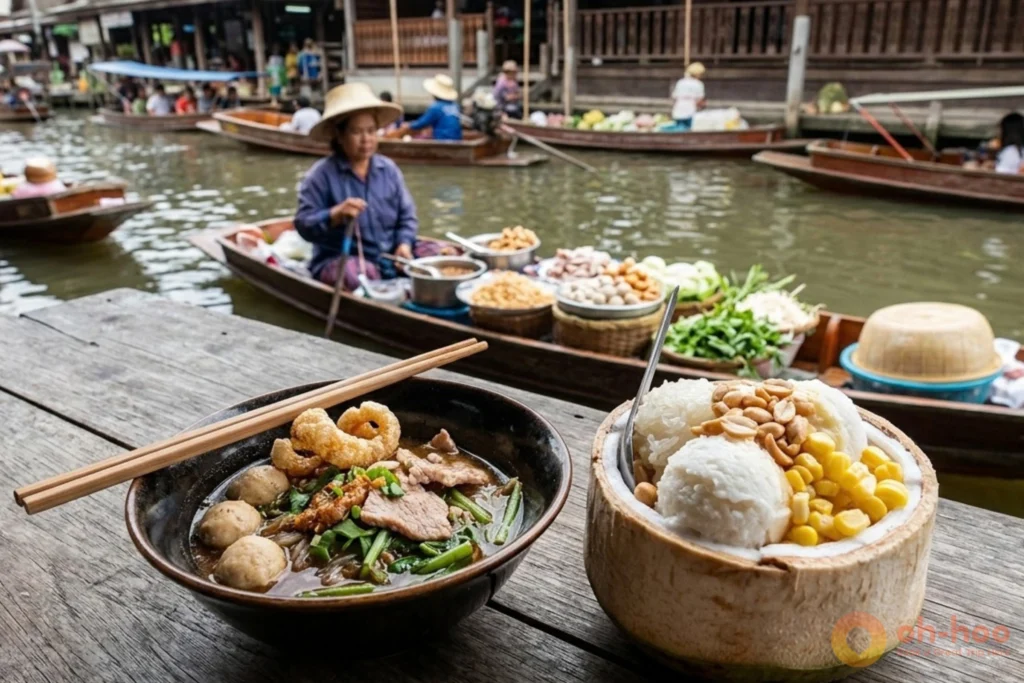
- Boat noodles – small, intense bowls of pork or beef noodle soup, handed up from a boat or served at canal-side stalls. Portions are deliberately small; two bowls is normal.
- Coconut ice cream, served in the shell with peanuts and sticky rice. The most photographed thing here, and genuinely good.
- Mango sticky rice, at its best in the mango months from around March to May.
- Kanom krok – small coconut-rice pancakes cooked in a dimpled pan, eaten hot in pairs.
- Grilled river prawns, squid and skewers along the walkways, cooked to order.
- Seasonal fruit – rambutan, mangosteen, pomelo and whatever else is being sold from the boats that week.
One thing worth knowing: buying from a boat and buying from a walkway stall are not the same price for the same item – the boats trade on novelty. Neither is expensive, but bring small notes; nobody is breaking a thousand-baht note at seven in the morning.
Practical Tips
A handful of things make the difference between a smooth morning and a frustrating one.
- Carry small notes: Card payment is essentially non-existent, and there is no reliable ATM at the market. Bring plenty of 20, 50, and 100-baht notes, as vendors rarely have change for 500 or 1,000-baht notes.
- Bring sun protection: The walkways and open boats are largely unshaded. Pack sunscreen, sunglasses, and a hat or light umbrella as the sun gets higher.
- Wear shoes you can move in: The walkways are narrow wooden boards—often damp—with steps down to the water. Opt for non-slip flats or sturdy sandals instead of open flip-flops or heels.
FAQ
Yes. There is no admission charge and no ticket booth. Your costs on the day are a boat if you want one, parking if you drive, and whatever you buy there.
Around 7:00 am until late morning, with some food vendors trading from about 6:00 am and most stalls packed up by midday. Times shift by season and vendor, so treat late morning as the end rather than a fixed closing time.
Yes, but expect a different market – busier, hotter, and more souvenir-focused. You still get the canal, the boats and the photographs. What you lose is the hour when vendors are trading with local customers rather than tour groups.
They suit different plans. Damnoen Saduak is a morning market trading daily, which is what makes it fit for a day trip from Bangkok. Amphawa generally runs in the afternoons and evenings, mainly at weekends, so it works better as a late-day or overnight trip. Check current days and times before planning around either.
The Morning Is the Whole Trip
Everything about Damnoen Saduak comes down to when you stand on that walkway. Free to enter, open from seven, largely finished by noon, two hours from Bangkok, and a completely different place at eight o’clock than at ten. Get the timing right and the rest of it – the boat, the noodles, the mango sticky rice, the hour on the water – falls into place on its own.
The easiest way to get it right is to let someone else set the alarm. The Maeklong Railway and Floating Market Tour from Bangkok collects you before dawn, covers the railway market, the long-tail boat ride, and the canal in one morning, and has you back in the city by early afternoon with the day still ahead of you.