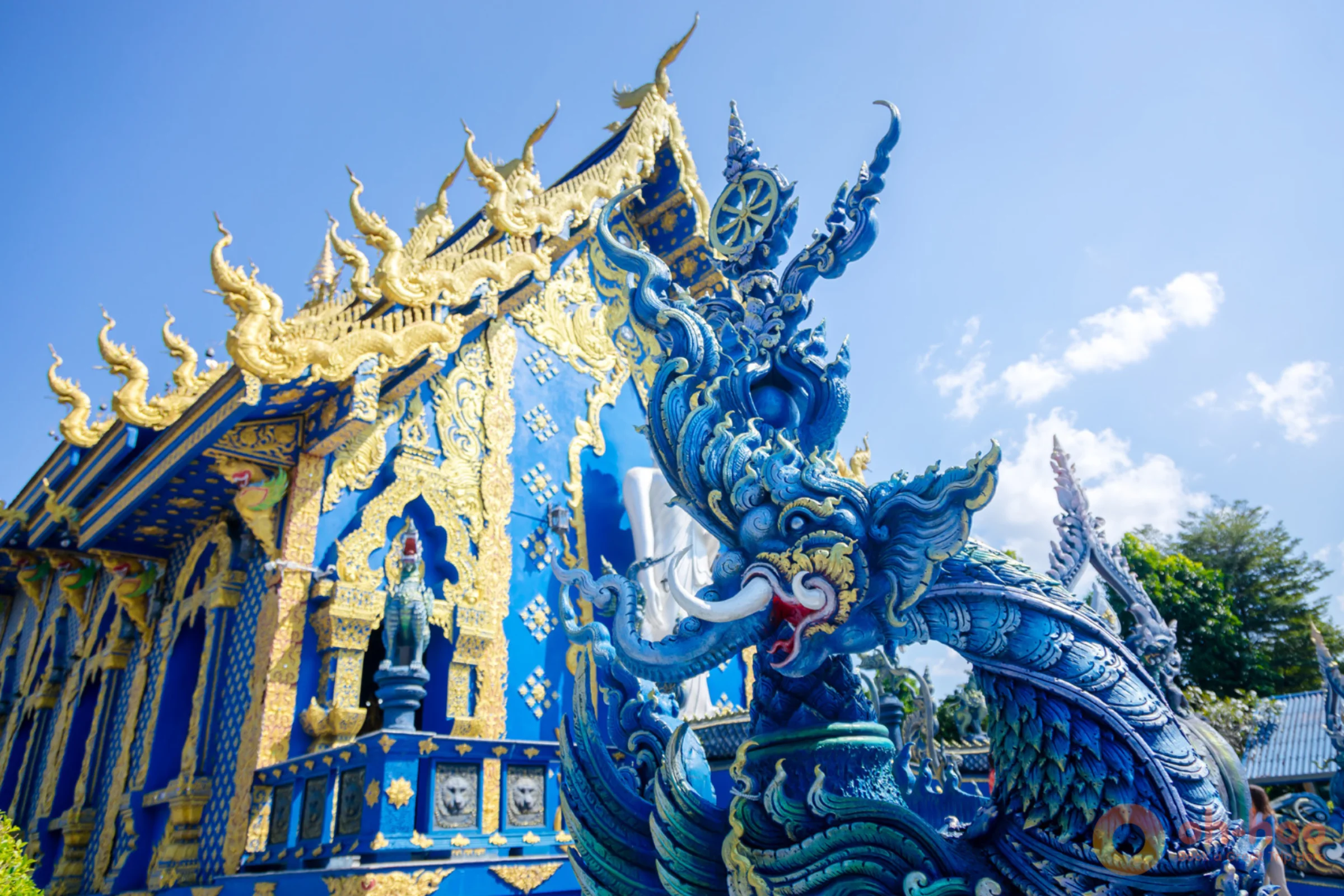
Nearly everyone who goes to Chiang Rai goes for the White Temple. The Blue Temple – Wat Rong Suea Ten – tends to get treated as the optional extra, the one you add if the day runs smoothly and skip if it does not.
That gets the maths backwards. The Blue Temple charges no entrance fee at all, sits ten minutes from the middle of Chiang Rai, and most visitors are done in under an hour. Adding it costs you a little time and no money, and it is the stop people tend to talk about afterwards – partly because the best of it is inside, which the photographs never quite prepare you for.
Here is what makes it worth the detour, what it costs (nothing), and how it fits around the temple everyone else came for.
What Makes the Blue Temple Different
It is easy to assume the Blue Temple is a copy of the White Temple in a different colour. It is closer to a younger sibling: same artistic family, different personality, and its own story on its own site.
- It was built by the White Temple artist’s student. Wat Rong Suea Ten was designed by Putha Kabkaew, who studied under Chalermchai Kositpipat – the artist behind Wat Rong Khun. The shared lineage explains why the two feel related without either being a version of the other.
- It is genuinely new, and genuinely finished. Work on the modern temple began in 2005 and was completed in 2016, which makes it one of the newest major temples in Thailand and one you see as its creator intended rather than mid-construction.
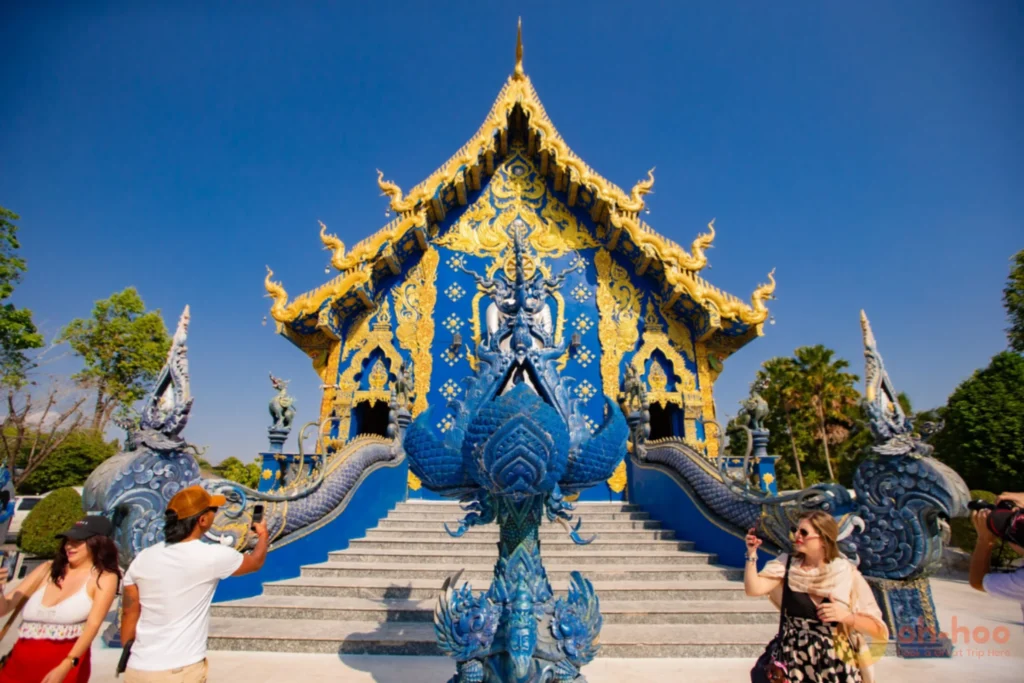
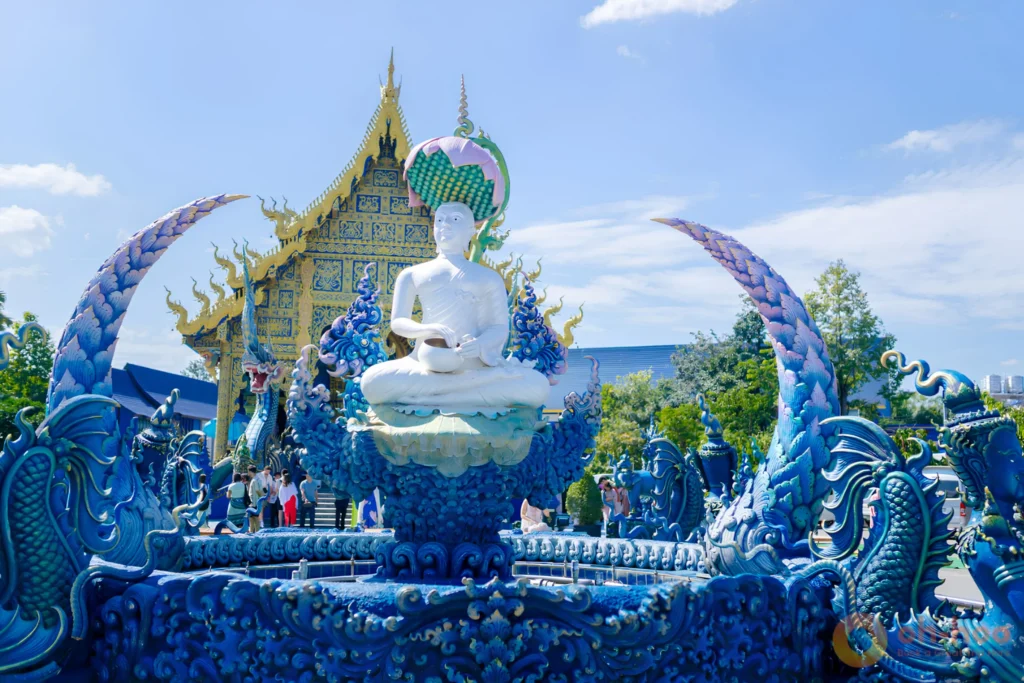
- The colour is the message. Deep sapphire blue set against gold is used here to stand for purity, wisdom, and letting go of attachment – not decoration for its own sake. The scale of it only registers in person; blue on this scale does something to flatten photographs.
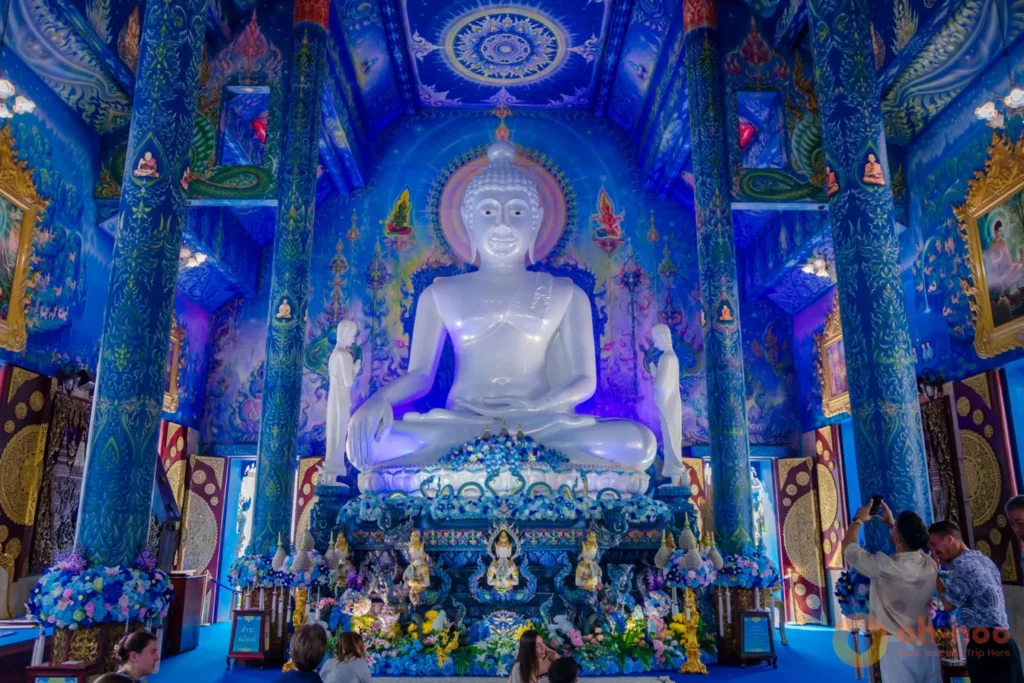
- The interior is the main event. A large white Buddha seated in the earth-touching mudra fills the end of the hall, against blue walls, blue-and-gold nagas and a painted ceiling that runs the length of the building. At the White Temple the exterior is the thing; here it is the other way round.
- The name has a story. Rong Suea Ten means roughly “the house where the tiger dances” – a reference to tigers that once crossed the river at this spot, on the site of a temple left abandoned for around a century before the community rebuilt it.
- It stays open late. Doors are open into the evening, and the building lit after dark is a different experience again – useful if your afternoon has already gone elsewhere.
- It is a working temple, not an attraction. Wat Rong Suea Ten was rebuilt by the community whose temple had stood on the site, and it still functions as one: monks live here, locals come to make merit, and there is no ticket gate between the car park and the hall. It is quieter and less managed than the big-name stops, and the difference in atmosphere is immediate.
Entrance Fee
This is the easy part of the article. There is no entrance fee at the Blue Temple.
- Entry is free for everyone, Thai and foreign visitors alike. There is no ticket counter and no separate charge for going inside the main hall.
- Donations are welcome, not required. There are donation boxes near the entrance and inside, and small notes are the normal contribution – they go towards upkeep of an active temple that is still maintained by its community.
- Opening hours are generous – roughly 07:00 to 20:00 daily, considerably longer than most temple attractions in the region.
- If you are on a day tour, the admission line on the booking – commonly around 280 THB – covers the sites that do charge, such as the White Temple and the Black House. The Blue Temple adds nothing to that number.
- Bring a little cash anyway, for the donation box and for the blue ice cream shop across the road, which is a genuinely good idea in April.
Standard temple etiquette applies: shoulders and knees covered, shoes off before entering the hall, voices down. Our White Temple guide covers the dress code in more detail, and the same rules serve you at both.
How Far From the White Temple
Closer than most itineraries assume, which is the practical reason to add it.
The two temples sit on opposite sides of Chiang Rai. The White Temple is about fifteen minutes south of the city centre; the Blue Temple is about ten minutes north of it. Driving from one to the other means crossing town – roughly half an hour, without leaving the city’s orbit.
Most people spend 30 to 60 minutes at the Blue Temple. So the full cost of adding it to a White Temple day is somewhere around an hour and a half, door to door, and nothing at the gate.
Under your own steam it is simple: a tuk-tuk or a ride-hailing car from central Chiang Rai takes about ten minutes each way, and there is a car park at the temple if you are driving. Agree on a return fare or wait with a tuk-tuk driver before you set off, since the temple sits on the edge of town and you will not find a queue of them waiting outside when you come out.
Which Order to Visit
Do the White Temple first. It is the busier of the two, and it closes earlier, so it is the one that punishes a late start. The Blue Temple, open until the evening, is the flexible half of the pair – which makes it the natural second stop whether your day runs early, late, or sideways.
On an organised trip, the order is decided for you, and it usually runs the same way: the White Temple while the day is fresh, the Blue Temple afterwards, with the Black House or a café between or after.
FAQ
No. Entry is free for everyone, and there is no extra charge to go inside the main hall. Donation boxes are available if you would like to contribute, and small notes are the usual amount. It is open daily from roughly 07:00 to 20:00.
Yes, and arguably more so. They were created by artists from the same lineage, but they work in opposite directions – the White Temple is an exterior to walk around, the Blue Temple an interior to stand inside. Seeing one does not give you the other, and the second costs nothing to add.
Comfortably. They are on opposite sides of Chiang Rai, about half an hour’s drive apart, and the Blue Temple takes under an hour to see. Most day trips from Chiang Mai cover both, along with the Black House or a café stop, and still get back the same evening.
Seeing Both in One Trip
The Blue Temple isn’t a substitute for the White Temple, and it doesn’t try to be. It is the stop that makes a Chiang Rai day feel complete rather than efficient: free to enter, quick to see, open late, and the one where people stop taking photographs and just sit down for a minute.
If you are coming from Chiang Mai, the straightforward version is a trip that already includes both. The White Temple, Black House and Blue Temple Full Day Trip takes in all three of Chiang Rai’s landmark sites with a hot spring stop on the way, transfers, lunch and a guide – the fullest version of the day. P: If you would rather not spend twelve hours on the road, the shorter Chiang Rai Temples Tour with Hot Spring keeps the hot spring, the White Temple and the Blue Temple and swaps the Black House for a garden café – a slower day with the same two temples in it.
Either way, do not let the Blue Temple be the thing you skip. It is the cheapest stop on the itinerary, and not by a small margin.